At the heart of New Delhi, a vast stone arch rises above one of India’s most familiar public spaces. India Gate is photographed by visitors, illuminated after sunset and remembered by generations of families who have walked around its lawns. Yet behind its dignified outline is a layered story of war, empire, independent India and national remembrance. The monument carries names, dates and symbols that connect the capital to events far beyond Delhi. Its broad avenues and open sky give it a sense of grandeur, but its deepest meaning is quieter: it asks people to remember soldiers whose lives were lost in conflicts many never witnessed. These ten interesting facts reveal the history, design and continuing importance of India Gate.
1. India Gate Stands in the Heart of New Delhi
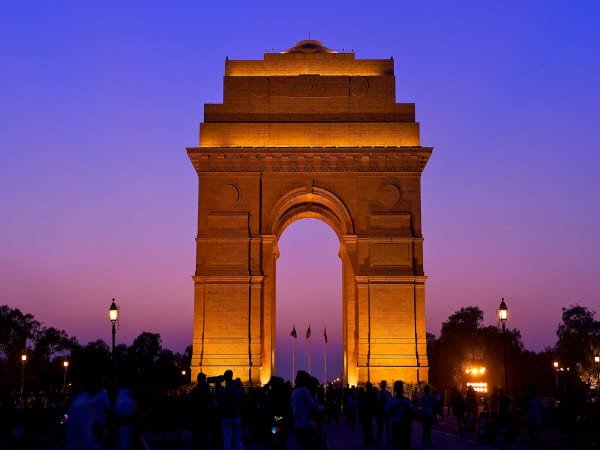
India Gate is located in central New Delhi, near the ceremonial avenue now known as Kartavya Path, formerly Rajpath. It stands at the centre of an important road axis and is surrounded by broad lawns, fountains and open public space. The setting was planned as part of New Delhi’s grand imperial-era layout. Today, however, the monument belongs to the everyday life of the capital. People visit for national ceremonies, evening walks, photography, family outings and quiet moments of remembrance. Its location has helped make India Gate not only a war memorial but also one of Delhi’s best-known public landmarks.
2. Its Foundation Stone Was Laid in 1921
The foundation stone of India Gate was laid in 1921 by the Duke of Connaught, a member of the British royal family. The monument was planned as a memorial to soldiers from the Indian subcontinent who served in the British Indian Army during the First World War and other conflicts. Its original purpose reflected the political world of colonial India. After independence, the meaning of the site developed in a new national context. The same structure is now seen by Indian visitors as a place connected with military sacrifice and public memory, even though its first design and dedication belonged to the colonial period.
3. Edwin Lutyens Designed the Monument
India Gate was designed by Sir Edwin Lutyens, the British architect who played a major role in planning New Delhi. His work shaped several important buildings and avenues in the capital. India Gate has a monumental, classical form, with a tall central opening, strong geometric lines and carefully balanced proportions. It is often compared with the Arc de Triomphe in Paris because both are large commemorative arches, although they are not identical. Lutyens used scale and simplicity to create a structure that can be seen from a distance and still feel powerful when approached on foot.
4. The Arch Is About 42 Metres High
India Gate rises approximately 42 metres above the ground. Its height gives it a commanding presence without making it feel like a closed building. The open arch allows the sky and surrounding avenue to remain part of the monument’s visual design. The structure stands on a low base and uses red and pale stone surfaces that change appearance with the daylight. From a distance, it looks like a single solid gateway; closer inspection reveals inscriptions, mouldings and carefully arranged architectural details. Its design depends as much on proportion and setting as on the stone itself.
5. It Commemorates Indian Soldiers Who Died in War
The monument commemorates Indian soldiers who served and died in the First World War and other campaigns. Delhi Tourism states that it honours around 70,000 Indian soldiers who lost their lives while serving in the British Army during the First World War. The arch also carries the names of more than 13,500 soldiers associated with the Northwestern Frontier and the Afghan War of 1919. These figures should be understood in the context of the memorial’s original inscriptions and colonial military records. India Gate therefore represents both the personal cost of war and the complicated history of Indian soldiers serving under colonial rule.
6. The Dates 1914 and 1919 Are Part of Its Design
The years MCMXIV and MCMXIX, representing 1914 and 1919 in Roman numerals, appear on the monument. They mark the period associated with the First World War and the campaigns remembered by the memorial. The word “INDIA” is also prominently carved into the structure. These details are easy to overlook when visitors focus on the arch’s size, but they turn the monument into a historical document. Its stone surface records the time period, the country and the military losses that the designers wanted future generations to remember.
7. Amar Jawan Jyoti Was Added After Independence
The eternal flame known as Amar Jawan Jyoti was installed beneath the arch after the 1971 India–Pakistan War. It became a powerful symbol of remembrance for Indian soldiers who died in service. The flame burned continuously for decades and was associated with national ceremonies, especially Republic Day observances. In 2022, the flame was merged with the National War Memorial flame at the nearby National War Memorial. The history of Amar Jawan Jyoti shows how India Gate’s meaning changed after independence and how newer memorial traditions have been added to older structures.
8. A Shallow Bowl Was Designed at the Top
At the top of the arch is a shallow domed bowl. According to Delhi’s official tourism description, it was intended to be filled with burning oil on important anniversaries, although this practice was rarely carried out. The bowl is a reminder that monumental architecture often includes ceremonial ideas that are not always used regularly. Small details like this can reveal the expectations surrounding a building when it was first designed. India Gate was not planned merely as a passageway; it was conceived as a stage for public memory, military honour and formal ceremony.
9. India Gate Becomes Dramatic After Sunset
The monument is floodlit at night, giving its stone surfaces a warm and dramatic appearance. The lighting makes the arch visible from the surrounding avenues and turns its outline into a familiar part of Delhi’s evening skyline. Nearby fountains and lawns add to the public atmosphere, especially during cooler months. Night-time visits have become part of the landmark’s popular identity, but the site is not only a recreational place. The contrast between bright lighting, open lawns and the names carved into the memorial can make the experience both festive and reflective.
10. It Is a Memorial, Landmark and Public Meeting Place
India Gate serves several purposes at once. It is a historic war memorial, an architectural landmark, a location for national remembrance and a public gathering place. School groups learn about it, visitors photograph it, families meet nearby and official ceremonies give it national visibility. This combination explains why India Gate remains important long after its construction. Monuments survive not only because of their stonework but because people continue to attach meaning to them. India Gate has been interpreted through colonial history, independence, military service and modern civic life, making it one of Delhi’s most recognisable symbols.
India Gate is more than a grand arch standing beside a busy avenue. Its stones preserve the memory of soldiers, the ambitions of colonial planners and the changing values of an independent nation. Its inscriptions invite historical questions, while its lawns and lights keep it connected to ordinary public life. The monument’s enduring power comes from this combination of scale and human feeling. Visitors may arrive to admire its architecture, but they leave with a reminder that national history is built from individual lives and sacrifices. India Gate continues to stand not only as a landmark of New Delhi, but as a place where memory remains visible in the middle of a living city.