Imagine standing on a small, grey world where the Sun appears more than three times larger than it does from Earth. The ground beneath your feet is covered with ancient craters, the sky is almost completely black, and a single sunrise can become a complicated event because the planet spins so slowly. This is Mercury, the smallest planet in the Solar System and the one that travels closest to the Sun. At first glance, it may look like a quiet ball of rock. In reality, Mercury is one of the most surprising worlds in space. It has a giant iron core, a weak but real magnetic field, polar ice hidden in permanent darkness and a surface shaped by impacts and shrinking rock. It is also difficult to explore because the Sun’s gravity makes reaching and orbiting it unusually demanding. These ten facts reveal why Mercury is much more than a hot planet near the Sun—and why studying it can teach scientists about the birth and development of rocky planets.
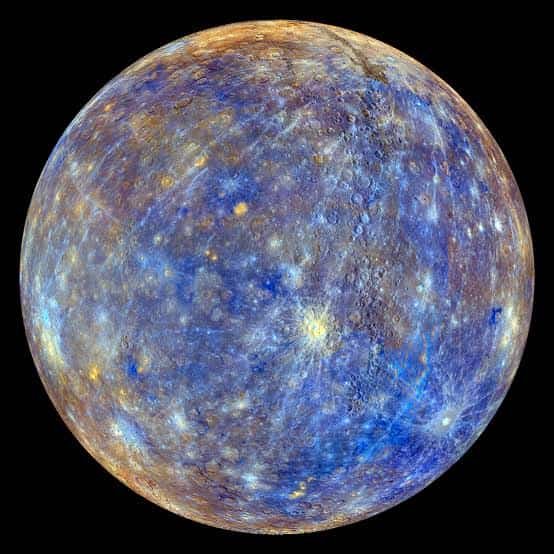
1. Mercury Is the Smallest Planet in the Solar System
Mercury is the smallest of the eight planets, with a radius of about 2,440 kilometres. It is only slightly larger than Earth’s Moon and is a little more than one-third as wide as Earth. If Earth were reduced to the size of a five-rupee coin, Mercury would be roughly the size of a blueberry. Its small size does not mean it is simple. Beneath its rocky surface lies a surprisingly large metallic core. Mercury is also the closest planet to the Sun, orbiting at an average distance of about 58 million kilometres, or 0.4 astronomical units. Sunlight takes only about 3.2 minutes to travel from the Sun to Mercury.
2. A Year on Mercury Lasts Only 88 Earth Days
Mercury completes one trip around the Sun in just 88 Earth days, making it the fastest planet in the Solar System. It moves through space at an average speed of about 47 kilometres per second. Its orbit is also noticeably elliptical, so its distance from the Sun changes from roughly 47 million to 70 million kilometres. This quick journey gave Mercury its name: the Romans named it after Mercury, the swift messenger of the gods. However, Mercury’s fast year is paired with a very slow rotation, which creates one of the strangest calendars in the Solar System.
3. One Solar Day on Mercury Is Longer Than Two Mercury Years
Mercury rotates once on its axis in about 59 Earth days, but a complete day-night cycle—from one noon to the next—lasts 176 Earth days. That is exactly two Mercury years. This happens because Mercury rotates three times for every two orbits it makes around the Sun, a relationship called a 3:2 spin-orbit resonance. Near some longitudes, the Sun may appear to rise, pause, move backward briefly and then rise again. A similar effect can occur at sunset. The strange motion is caused by Mercury’s changing orbital speed and its slow rotation, not by the Sun actually reversing direction.
4. Mercury Is Not the Hottest Planet
Because Mercury is closest to the Sun, many people assume it must be the hottest planet. The title actually belongs to Venus. Venus has a dense carbon-dioxide atmosphere that traps heat through a powerful greenhouse effect. Mercury has almost no atmosphere to spread or retain heat, so its surface temperatures change dramatically. Sunlit regions can reach about 430°C, while the night side can fall to around –180°C. The contrast is extreme because heat escapes quickly after sunset. Mercury’s average temperature is therefore lower than Venus’s, even though Mercury receives much stronger sunlight.
5. Mercury Has a Giant Iron Core
Mercury is the second-densest planet after Earth, and its density is largely explained by its enormous iron-rich core. The core has a radius of about 2,074 kilometres—around 85 percent of the planet’s total radius. By comparison, Earth’s core occupies a smaller proportion of the planet. Scientists are still investigating why Mercury developed such a large metallic interior. Possible explanations include a powerful early collision that stripped away part of its rocky outer layers, or the effects of intense heat and chemical conditions during the Solar System’s formation. Mercury’s unusual interior makes it an important clue to how rocky planets are built.
6. Its Surface Is Covered with Ancient Craters and Cliffs
Mercury’s grey, heavily cratered landscape resembles the Moon because both worlds have been struck by asteroids and comets for billions of years. One of its largest features is the Caloris Basin, an impact structure about 1,550 kilometres wide. The collision that created it released so much energy that it affected terrain on the opposite side of the planet. Mercury also has long cliffs, called lobate scarps, some of which rise nearly a kilometre high and extend for hundreds of kilometres. These cliffs formed as the planet’s interior cooled and contracted. Mercury is still slowly shrinking, leaving geological evidence of its changing interior.
7. Water Ice Exists on the Closest Planet to the Sun
Mercury’s polar ice is one of the Solar System’s most counterintuitive discoveries. Deep craters near the north and south poles have floors that sunlight never reaches. Because Mercury’s axis is tilted by only about two degrees, the Sun remains very low near the poles. In these permanently shadowed places, temperatures can stay cold enough for water ice to survive, even while nearby sunlit ground becomes scorching hot. Radar observations and data from NASA’s MESSENGER spacecraft support the presence of water ice in these shadows. Some deposits may be covered by a dark layer of organic material delivered by comets or asteroids.
8. Mercury Has an Exosphere Instead of a Normal Atmosphere
Mercury does not have a thick atmosphere like Earth, Mars or Venus. Instead, it has an extremely thin exosphere—a sparse layer of individual atoms that rarely collide with one another. These atoms come from several sources, including the solar wind, tiny meteorite impacts and particles released from the surface by sunlight. The exosphere contains elements such as oxygen, sodium, hydrogen, helium and potassium. Since it cannot hold heat or create weather in the ordinary sense, Mercury has no familiar clouds, rainstorms or strong winds. The exosphere is weak, but it is scientifically valuable because it records interactions between the surface, sunlight and the solar wind.
9. Mercury Has a Magnetic Field
Mercury is a small rocky planet, yet it has a global magnetic field. Its field is only about one percent as strong as Earth’s, but it is strong enough to interact with the solar wind—the stream of charged particles flowing from the Sun. Scientists believe that part of Mercury’s large iron core remains liquid and moves in a way that generates the field. The magnetic field is not centred perfectly on the planet’s equator; it is slightly offset. When solar-wind particles are funnelled toward the surface, they can knock atoms loose and help replenish the exosphere. Mercury therefore offers a rare chance to study how a weak planetary magnetic field behaves so close to a star.
10. Reaching Mercury Is Harder Than It Looks
Mercury is closer to Earth than many outer planets, but sending a spacecraft there is extremely difficult. A probe travelling inward must lose a great deal of speed because the Sun’s gravity pulls it into a faster orbit. Reaching Mercury is not simply a matter of pointing a rocket at the planet. Spacecraft use carefully planned gravity assists and long periods of electric propulsion to slow down and adjust their path. NASA’s Mariner 10 was the first spacecraft to visit Mercury, and NASA’s MESSENGER later became the first to orbit it. The joint ESA-JAXA BepiColombo mission is scheduled to enter orbit in late 2026, with its main scientific work expected to begin in 2027. Its instruments will study Mercury’s interior, surface, exosphere and magnetic environment in much greater detail.
A Small Planet with Big Mysteries
Mercury may be the smallest planet, but it contains an extraordinary collection of scientific puzzles. Its rapid orbit, slow rotation, giant iron core, shrinking crust, polar ice and magnetic field show that a world does not need to be large to be complex. The planet’s harsh environment also reminds us that distance from the Sun alone does not decide temperature, habitability or geological activity. Every crater and cliff is part of Mercury’s long history, while every spacecraft measurement helps scientists understand how rocky planets form and change. As new missions investigate this sunlit and shadowed world, Mercury continues to prove that the Solar System’s most familiar-looking objects can still hide its deepest surprises.