Hyderabad is a city where centuries-old arches stand within sight of glass office towers, where the aroma of biryani rises from busy lanes and where a lake, a fort, a palace and a technology campus all belong to the same urban story. Known as the City of Pearls and the City of Nizams, Hyderabad blends Telugu traditions with Deccan, Persian, Turkish and Mughlai influences. It is at once historic and ambitious, traditional and technology-driven. From the legendary Charminar and the echoing walls of Golconda Fort to HITEC City, Genome Valley and its famous food culture, Hyderabad offers far more than a list of tourist attractions. These ten facts explore the history, architecture, science, cuisine and character that make the city distinctive.
1. Hyderabad Was Founded by the Qutb Shahi Dynasty
Hyderabad was founded in 1591 by Muhammad Quli Qutb Shah, the fifth ruler of the Qutb Shahi dynasty. The new city developed on the southern bank of the Musi River and gradually became an important centre of administration, trade and culture. Its foundation marked a shift from the older fortified capital of Golconda toward a planned urban settlement. Over time, Hyderabad absorbed influences from Telugu-speaking communities, Persian court traditions, Deccan culture and later rulers. This layered history is still visible in its language, buildings, music, festivals and food.
2. Charminar Is the City’s Best-Known Landmark
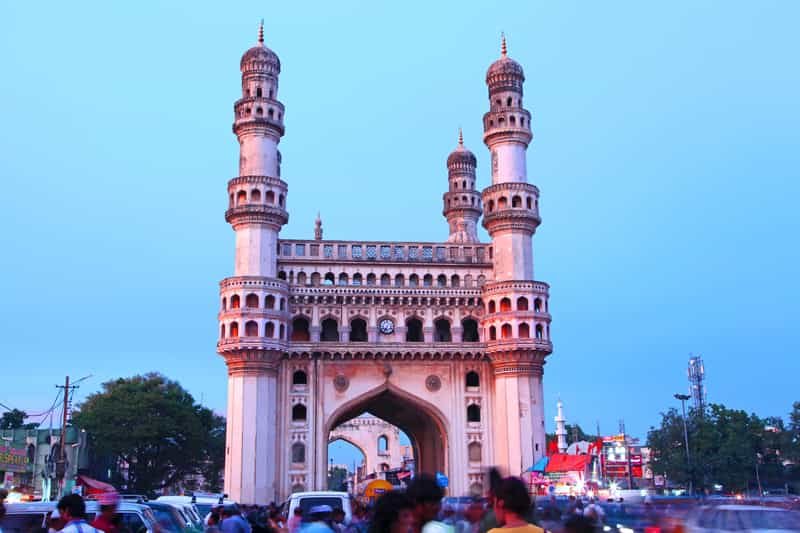
Charminar was built in 1591 and has become the visual symbol of Hyderabad. The square monument has four grand arches and four minarets rising from its corners. Its design combines Islamic architectural features with elaborate decorative details, and a mosque occupies the upper level. The exact reason for its construction is debated. Popular traditions connect it with the end of a plague, the founding of the city or a religious commemoration. The monument stands at the centre of an old commercial area filled with bazaars, jewellery shops, bangles and street food.
3. Golconda Fort Was Once a Powerful Capital
Golconda Fort began as an early hill settlement and later became the principal capital of the Qutb Shahi rulers. The massive complex includes walls, gateways, palaces, mosques, halls, reservoirs and elevated viewpoints. Its builders used the landscape and sound cleverly. A clap near the entrance is traditionally said to be heard at a pavilion on the hill, creating a communication system within the fort. Golconda was also associated with the diamond trade, and the wider region became famous for valuable stones. The Koh-i-Noor is often linked with the Golconda mines, although the history of individual diamonds is complex.
4. Hyderabad Has a Famous Nizam and Paigah Heritage
For much of its modern history, Hyderabad was ruled by the Nizams, whose court became known for wealth, administration, architecture and cultural patronage. Palaces such as Chowmahalla and Falaknuma preserve glimpses of this royal world. Falaknuma Palace, whose name means “like the sky”, was designed with Italian and Tudor influences and is associated with the Nizam’s later period. The city’s heritage also includes Paigah nobles, whose tombs and residences display delicate stucco work and distinctive Deccan design. These buildings show that Hyderabad’s history cannot be reduced to one dynasty or one architectural style.
5. Hyderabadi Cuisine Is a Cultural Melting Pot
Hyderabadi food reflects the meeting of Telugu, Persian, Turkish, Mughlai, Arabic and Central Asian influences. Biryani is the best-known dish, but the city’s culinary identity includes haleem, mirchi ka salan, baghara baingan, kebabs, khubani ka meetha and many local breads and sweets. Cooking techniques often involve slow cooking, fragrant spices, rice, meat, lentils, tamarind and dried fruits. In 2019, UNESCO recognised Hyderabad as a Creative City of Gastronomy. The recognition reflects not just famous dishes, but the skills, traditions and communities that keep the food culture alive.
6. Hussain Sagar Lake Connects Two Urban Areas
Hussain Sagar is a large historic lake between Hyderabad and Secunderabad. It was built during the reign of Ibrahim Quli Qutb Shah and later became an important landmark for both parts of the twin-city region. A large statue of Gautama Buddha stands on a rock in the middle of the lake, reached by boat. The necklace road around the lake is associated with public spaces, views and city events. Like many urban lakes, Hussain Sagar also faces pollution and pressure from development, making conservation important for the city’s environment and quality of life.
7. Hyderabad Is a Major Technology and Business Hub
The western part of Hyderabad, especially HITEC City and the wider Cyberabad area, has become a major centre for information technology, global capability centres, finance and research. Modern office districts stand beside residential communities, shopping areas and transport corridors. Companies use Hyderabad for software development, cloud services, data science, cybersecurity and business operations. The city’s large pool of engineering and science graduates has helped attract both Indian and international firms. This technology economy has changed the city’s skyline and created new jobs, while also bringing challenges such as traffic, rising housing costs and pressure on infrastructure.
8. Genome Valley Strengthens Hyderabad’s Life-Sciences Identity
Hyderabad is also known for pharmaceuticals, biotechnology, vaccines and life-sciences research. Genome Valley, located in the city’s wider metropolitan region, brings together research institutions, laboratories, manufacturing units and technology companies. The city’s pharmaceutical base has earned it a reputation as an important health and life-sciences centre in India. This sector connects Hyderabad with global medicine supply chains and scientific research. Its growth shows that the city’s modern identity is not limited to software; chemistry, biology, clinical research and manufacturing are equally important parts of its economy.
9. The City Has a Distinctive Deccani Culture
Hyderabad’s cultural character is shaped by the Deccan, a region with its own history, languages and artistic traditions. Dakhni Urdu developed through contact among local languages and court cultures, while Telugu remains central to the wider region’s identity. The city is known for poetry, qawwali, classical and folk music, handicrafts, pearls, bangles and a relaxed style of conversation often associated with Hyderabadi humour. Festivals and neighbourhood traditions bring together different communities. This cultural mixture is one reason Hyderabad feels different from both northern Mughal cities and many other South Indian capitals.
10. Hyderabad Combines Heritage with a Changing Future
Hyderabad’s greatest feature may be the way old and new exist side by side. A historic market can lead to a modern shopping district; a palace may stand near a busy road; and traditional food is served in both family kitchens and contemporary restaurants. The city is expanding through transport projects, technology parks, residential areas and new institutions. Growth brings opportunity, but it also demands careful planning. Protecting lakes, monuments, old neighbourhoods and public spaces is essential. Hyderabad’s future will be strongest when economic progress adds to its heritage instead of erasing it.
Hyderabad is more than Charminar, biryani or a technology campus, although each is an important part of its identity. It is a city shaped by dynasties, languages, trade, science, food, lakes and constant movement. Its past survives in stone arches and palace courtyards, while its future is being built in laboratories, offices and expanding neighbourhoods. The real charm of Hyderabad lies in this conversation between history and ambition. To understand the city is to see how different cultures can combine, change and create something unmistakably their own.