Imagine a landscape that changes from ancient desert to salt-white plain, from busy ports to quiet forests, and from old stone stepwells to modern industrial cities. This is Gujarat, a western Indian state shaped by the Arabian Sea, centuries of trade and a culture that celebrates both enterprise and tradition. Gujarat is home to the ancient Harappan city of Dholavira, the Asiatic lion of Gir, the historic walled city of Ahmedabad and the colourful circular rhythms of Garba. Its geography is equally varied: the Rann of Kutch stretches across a dramatic salt landscape, while the Narmada and other rivers support farms, towns and industries. Gujarat has also played an important role in India’s freedom movement and economic development. These ten facts look beyond familiar images and explore the history, wildlife, culture, geography and achievements that make Gujarat one of India’s most distinctive states.
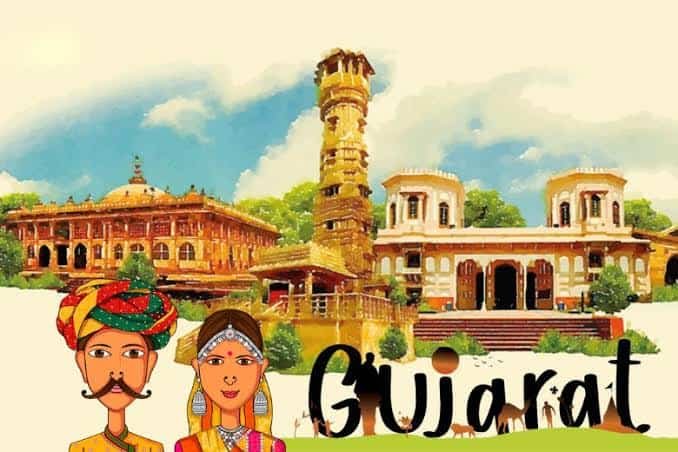
1. Gujarat Was Formed as a Separate State in 1960
Gujarat became a separate state on 1 May 1960 after the former Bombay State was reorganised largely along linguistic lines. Gujarati-speaking regions formed Gujarat, while Marathi-speaking regions became Maharashtra. Gandhinagar serves as the capital, and Ahmedabad is the largest city and a major commercial centre. The state occupies an important position in western India, bordered by Rajasthan, Madhya Pradesh and Maharashtra, with the Arabian Sea along its western and southern edges. Its identity developed through the interaction of many historical regions, including Kutch, Saurashtra, north Gujarat and south Gujarat. This variety helps explain why the state has several landscapes, dialects, food traditions and local customs rather than one single cultural pattern.
2. Gujarat Has India’s Longest Coastline
Gujarat has the longest coastline of any Indian state, stretching for roughly 1,600 kilometres when its many inlets and coastal curves are counted. The coastline includes the Gulf of Kutch and the Gulf of Khambhat, along with estuaries, beaches, mudflats, salt marshes, mangroves and coral-rich marine habitats. This location has influenced Gujarat for thousands of years. Coastal communities developed fishing, salt production, shipbuilding and maritime trade, while ports connected the region with the Arabian Peninsula, East Africa and other parts of the Indian Ocean world. Today, the coast remains important for commerce, energy, manufacturing and fisheries. It is also ecologically valuable because coastal wetlands and mangroves provide shelter for wildlife and help reduce erosion.
3. Dholavira Reveals the Engineering of the Harappan Civilization
On the arid island of Khadir in the Rann of Kutch lies Dholavira, one of the best-preserved urban settlements of the Harappan Civilization. The city was occupied approximately between 3000 and 1500 BCE and flourished for around 1,500 years. Its ruins show carefully planned streets, fortified sections, houses, a cemetery, workshops and an impressive system of reservoirs and water channels. Water was precious in this dry region, so the city’s designers created ways to collect and store seasonal flows. Archaeologists have also found beads, ornaments, metal objects, pottery and evidence of long-distance trade with other Harappan centres, Mesopotamia and the Oman peninsula. Dholavira became a UNESCO World Heritage Site in 2021 and offers a remarkable picture of ancient urban planning.
4. The Rann of Kutch Is a Vast Seasonal Salt Landscape
The Rann of Kutch is one of Gujarat’s most recognisable natural landscapes. During the dry season, large areas appear as a brilliant white salt plain stretching towards the horizon. During the monsoon, parts of the low-lying region are covered by water before gradually drying and leaving behind salt deposits. The word ‘Rann’ is connected with a desert or salt-marsh landscape, but the region is not lifeless. It supports specialised plants and animals adapted to heat, salinity and changing water levels. The larger Kutch region also contains grasslands, villages and craft communities. The stark landscape changes dramatically with the season, light and weather, which is why the Rann is both a geographical wonder and an important part of Gujarat’s cultural image.
5. Gir Is the Last Natural Home of the Asiatic Lion
Gir and the surrounding Saurashtra landscape support the world’s only surviving wild population of Asiatic lions. The species once ranged across much larger parts of Asia, but hunting, habitat loss and other pressures reduced its numbers severely. Conservation work in Gujarat, supported by forest staff and local communities, helped the population recover from the edge of extinction. Gir is not only a lion habitat; its forests and grasslands also support leopards, chital, sambar, nilgai, wild boar, jackals, crocodiles and many bird species. The survival of the Asiatic lion is an important conservation achievement, but it also creates responsibilities. Protecting corridors, managing human-wildlife contact and maintaining healthy prey populations are essential for the species’ future.
6. Ahmedabad Is India’s First UNESCO World Heritage City
The historic walled city of Ahmedabad was founded by Sultan Ahmad Shah in 1411 on the eastern bank of the Sabarmati River. In 2017, it became India’s first city to be inscribed as a UNESCO World Heritage City. The old city contains gates, walls, mosques, tombs, Hindu and Jain temples, markets and traditional wooden homes. Its distinctive neighbourhoods, known as pols, are arranged through closely connected streets and shared community spaces. Bird feeders, wells, courtyards and religious buildings form part of the historic urban fabric. Ahmedabad’s heritage is especially interesting because it reflects centuries of interaction among different communities and architectural traditions. It is a living city, not merely an archaeological monument.
7. Rani-ki-Vav Is an Inverted Temple of Water
At Patan stands Rani-ki-Vav, or the Queen’s Stepwell, an 11th-century monument built beside the Saraswati River. It was originally created as a memorial for a king but also served as an elaborate water structure. Instead of rising upward like a conventional temple, it descends into the earth through seven levels of steps and sculpted galleries. UNESCO describes it as an ‘inverted temple’ that expresses the sacred importance of water. More than 500 principal sculptures and over a thousand smaller ones decorate the structure, showing religious, mythological and secular scenes. The stepwell demonstrates that water management in historical India could be practical, artistic and spiritually meaningful at the same time.
8. Garba of Gujarat Is Recognised by UNESCO
Garba is one of Gujarat’s most famous cultural traditions, especially during Navaratri. Dancers move in circles around a lamp placed inside a perforated earthen pot or around an image of the goddess Amba. The circular movement represents devotion, continuity and the cycle of life, while clapping, singing and rhythmic footwork create a shared performance. Garba is not restricted to one age group or social setting; it is practised in villages, cities, schools, community grounds and large public events. UNESCO inscribed Garba of Gujarat on its Representative List of the Intangible Cultural Heritage of Humanity in 2023. The recognition highlights how the tradition is passed from one generation to another and how it brings together people from different communities.
9. Gujarat Has a Strong Maritime and Industrial Economy
Gujarat’s coastline and trading history helped it develop a broad modern economy. Ports connect the state with international shipping routes, while cities and industrial areas are known for petrochemicals, pharmaceuticals, textiles, engineering, ceramics, chemicals, automobiles and gems and jewellery. Agriculture remains important too, with cotton, groundnuts, dates, sugarcane, milk and other products supporting rural livelihoods. The cooperative dairy movement also made Gujarat famous for Amul, a brand that grew from farmers’ collective effort in Kheda district. This combination of ports, manufacturing, agriculture, trade and entrepreneurship gives the state an unusually diverse economic base. It also means that environmental protection and careful management of water, land and coastal ecosystems are important parts of Gujarat’s future.
10. Gujarat Is Closely Linked with Mahatma Gandhi and Sardar Patel
Gujarat is associated with two major figures in India’s modern history. Mahatma Gandhi was born in Porbandar and spent important years in Ahmedabad, where Sabarmati Ashram became a centre of reflection, public work and the freedom movement. The Sabarmati Ashram is closely connected with the Dandi March of 1930, Gandhi’s protest against the British salt laws. Gujarat was also the home state of Sardar Vallabhbhai Patel, who played a leading role in India’s independence movement and later helped integrate hundreds of princely states into the Indian Union. The Statue of Unity near Kevadia, standing 182 metres tall, honours Patel. Together, these places and people connect Gujarat’s landscape with the larger story of India’s struggle for freedom and national unity.
A State Where History Keeps Moving
Gujarat’s character comes from contrast. Ancient reservoirs stand in a dry landscape, while modern ports move goods across the sea. A quiet forest protects the Asiatic lion, and a crowded city preserves centuries-old homes and places of worship. Garba brings people together in celebration, while Dholavira reminds us that Gujarat’s history reaches back to one of the world’s earliest urban civilisations. Its coastline, industries, farms, crafts, wildlife and freedom-movement landmarks all form part of the same larger story. Gujarat is not defined by one monument or one festival. It is a state where heritage remains connected to daily life—and where the past continues to influence the way people work, celebrate, build and imagine the future.