Picture an African morning: golden light spills across the savanna, grasses tremble, and above the thorn trees a giraffe rises like a living tower. With its extraordinary neck, patterned coat and elegant stride, it seems almost too unusual to have been designed by nature. Yet every part has a purpose. Its height reaches food, its tongue handles thorns, and its circulation keeps blood moving between heart and brain. Giraffes have inspired legends, but their real story is even more fascinating. They are specialised survivors, gentle browsers, alert parents and important members of the African ecosystem. From ossicones to the arrival of a calf, these facts reveal why giraffes are among Earth’s most captivating mammals.
1. Giraffes Are the Tallest Mammals on Earth
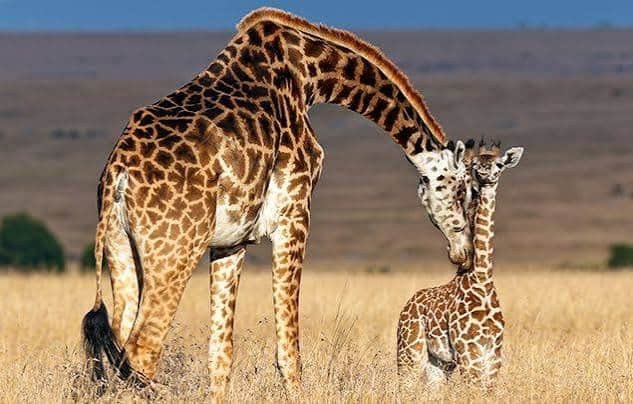
A fully grown giraffe can reach about 5.7 metres from the ground to its ossicones, the small horn-like structures on its head. That height gives it a superb view across open woodland and lets it browse on leaves most herbivores cannot reach. Adult males are usually taller and heavier, and a large male may weigh close to two tonnes. Their height is not just impressive; it is a feeding advantage. While zebras and antelope graze below, giraffes harvest fresh leaves high in the canopy, reducing competition for food.
2. Their Long Necks Have Only Seven Bones
The length of a giraffe’s neck can make it appear to have many neck bones, but it has the same basic count as a human: seven cervical vertebrae. Each is greatly elongated, with strong joints and muscles supporting the weight. This shows evolution modifying an existing body plan rather than inventing a new one. The neck also acts as a counterbalance when the giraffe walks, bends to drink or swings its head during an encounter with another male.
3. A Powerful Heart Solves a Serious Blood-Pressure Problem
A giraffe’s brain sits roughly two metres above its heart, so the animal must send blood upward against gravity. Its heart is large and powerful, and the arteries in its neck have thick, muscular walls. Special valves and elastic blood vessels help control the pressure when the giraffe lowers or raises its head. Without these adaptations, standing up quickly could cause dangerous pressure changes or make the animal faint. When a giraffe spreads its front legs and lowers its head to drink, its circulatory system is performing an extraordinary piece of natural engineering.
4. Their ‘Horns’ Are Called Ossicones
The structures on a giraffe’s head are not true horns like those of cattle or antelope. They are called ossicones and are made of bone covered by skin and hair. Both males and females have them, although they can become thicker and more prominent in males. Young giraffes are born with ossicones lying flat against the skull, helping prevent injury during birth; they gradually become upright. Males sometimes fight by swinging their necks and striking opponents with their heads, a behaviour known as necking. The contest can look slow, but the blows can be remarkably forceful.
5. Every Giraffe Has a Distinctive Coat Pattern
No two giraffes have exactly the same arrangement of patches. Colours and shapes vary between individuals and populations. The patterns help break up the body among sunlight, branches and shadow, providing camouflage. A calf can also recognise its mother through her appearance, smell and voice. The patches may have another benefit: darker areas contain networks of blood vessels close to the skin, so researchers suggest they could help release heat. The pattern is both a visual signature and a possible part of the giraffe’s thermal toolkit.
6. Their Tongues Are Designed for Thorny Trees
A giraffe’s tongue can extend to around 45 centimetres and is flexible enough to wrap around individual leaves. Its dark blue-black colour is often linked to protection from intense sunlight, although the exact reason for the pigmentation is still being studied. The tongue, tough lips and thick saliva allow giraffes to feed on acacia and other thorny plants that would injure many animals. They use their lips and tongue with surprising precision, pulling leaves free while avoiding sharp spines. Their mouths are so well adapted to browsing that thorns are less a barrier than a source of food.
7. Giraffes Spend Much of the Day Eating
Browsing takes up much of a giraffe’s day. It may feed for 16 to 20 hours, taking mouthfuls of leaves and chewing as it moves through its habitat. Like cows and deer, giraffes are ruminants: food is swallowed, partly digested and later brought back up to be chewed again. They do not need to drink as often as many animals because leaves provide moisture. When they drink, they must spread their front legs or bend their knees, placing them in a vulnerable position.
8. A Newborn Calf Begins Life with a Dramatic Drop
After a pregnancy lasting about 13 to 15 months, a mother giraffe gives birth standing up. The newborn therefore enters the world with a short fall of roughly 1.5 metres. The impact sounds alarming, but it helps stimulate the calf’s first breaths and movement. Within a short time, the calf attempts to stand, and soon after it can walk beside its mother. This speed matters because young giraffes are vulnerable to lions, hyenas and other predators. A calf grows rapidly during its first year and gradually becomes more independent while remaining closely connected to its mother.
9. They Can Run Faster Than Their Graceful Walk Suggests
Giraffes usually move with a calm, rolling gait, lifting both legs on one side of the body in a style called a pace. When danger appears, they can accelerate into a gallop and reach roughly 60 kilometres per hour in short bursts. Their long legs make tight turns difficult, but they are effective in open country. A giraffe can also deliver a powerful kick in self-defence, especially when protecting a calf. Its height may make it look slow, yet the animal combines speed, reach and strength when survival demands it.
10. Giraffes Are Social Animals Facing a Quiet Crisis
Giraffes gather in loose, changing groups rather than permanent herds with a strict leader. Individuals may join or leave, while mothers and calves form important bonds. Their presence also benefits wildlife: a tall giraffe can spot danger, and its browsing opens vegetation and spreads seeds. Yet giraffe populations have declined sharply because of habitat loss, fragmentation, human-wildlife conflict and illegal hunting. The species is recognised as vulnerable, and several populations face greater danger. Protecting woodland, migration routes and local communities is essential to keeping these animals in the wild.
Why Giraffes Deserve Our Wonder and Protection
Giraffes are unforgettable because they combine enormous height with delicate movement, a powerful heart with a gentle presence, and a simple diet with specialised anatomy. Their necks, coats, tongues and fast-growing calves are solutions shaped by life on the African savanna. But admiration must become responsibility. When forests are cleared and landscapes divided, giraffes lose food and safe routes. Protecting them also protects the ecosystem they help maintain. The next time a giraffe appears above the trees, see more than an icon of elegance: it is a living masterpiece whose future depends on human care.