Asia is so vast that it is difficult to describe it as one place. It contains frozen Arctic coastlines, tropical islands, high mountain deserts, ancient river valleys and some of the world’s busiest modern cities. In one part of the continent, people live beside rice fields and monsoon forests; in another, reindeer cross snowy plains beneath the northern lights. Asia has shaped global history through its religions, inventions, trade routes, empires, literature and food, yet it remains a continent of astonishing variety rather than a single cultural story. From the Himalayas to the Pacific, these ten interesting facts reveal the scale, diversity and surprising connections that make Asia unlike anywhere else on Earth.
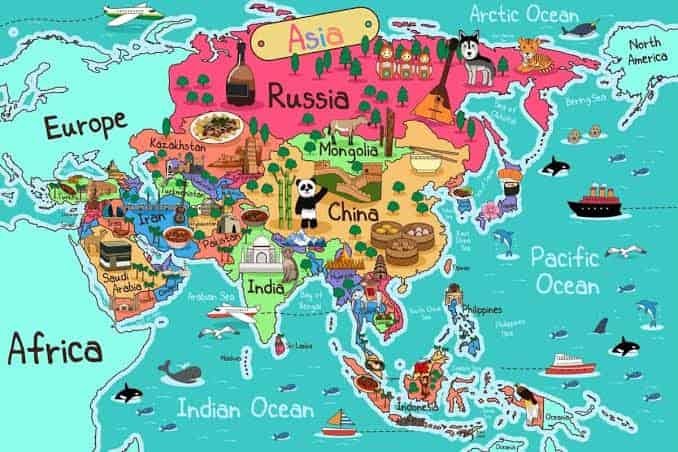
1. Asia Is the World’s Largest Continent
Asia is the largest continent by both land area and population. It covers roughly one-third of Earth’s total land surface and stretches from the Arctic Ocean in the north to the equatorial islands of Southeast Asia. Its enormous size creates extraordinary differences in climate, landscapes and lifestyles. The continent includes Siberian tundra, Arabian deserts, tropical rainforests, fertile plains and high-altitude plateaus. Asia is not separated from Europe by a wide ocean; together they form the great landmass called Eurasia. The boundary between the two is partly geographic and partly historical, which is why the idea of a separate “continent” is also a matter of human classification.
2. Asia Contains More Than Half of the World’s People
More than half of humanity lives in Asia. China and India alone have populations measured in billions, while Indonesia, Pakistan, Bangladesh and Japan are also home to very large communities. Population is not spread evenly. Huge numbers of people live in river valleys, coastal plains and fertile farming regions, while deserts, high mountains and cold northern areas are far more thinly populated. This concentration has produced some of the world’s largest cities, but it has also created challenges involving water, housing, transport, pollution and food supply. Asia’s population is not simply a statistic; it represents thousands of languages, traditions, occupations and family histories.
3. The Himalayas Are Still Rising
The Himalayas were formed when the Indian tectonic plate pushed northward into the Eurasian plate. That collision continues today, so the mountains are still rising slowly even as wind, ice and rivers wear them down. Mount Everest, on the Nepal–China border, is the highest point above sea level. The Himalayas also contain glaciers and snowfields that feed major rivers, including the Ganges, Brahmaputra and Indus. These waters support farms, cities and ecosystems far beyond the mountain valleys. The range is therefore more than a dramatic skyline; it is a vital water tower for a large part of Asia.
4. Asia Has Both the Highest and Some of the Lowest Landscapes
Asia contains remarkable extremes of elevation. The summit of Mount Everest rises more than eight kilometres above sea level, while the Dead Sea shoreline in the Jordan Rift Valley lies hundreds of metres below sea level. The Tibetan Plateau is often called the “Roof of the World” because much of it sits higher than 4,000 metres. At such heights, the air is thinner, temperatures can change quickly and plants and animals need special adaptations. These contrasts show how much of Earth’s vertical variety is concentrated within one enormous continent.
5. The Continent Has Thousands of Islands
Asia includes some of the world’s largest and most heavily populated island regions. Indonesia alone is made up of thousands of islands spread across the Indian and Pacific oceans. Japan, the Philippines and the Indonesian archipelago sit along active tectonic zones, where earthquakes and volcanic eruptions are part of the natural landscape. Islands have also encouraged unique evolution: animals isolated on separate landmasses may develop different body sizes, behaviours and habitats. At the same time, island communities often depend heavily on healthy seas for food, transport and livelihoods. Asia’s geography is therefore both continental and maritime.
6. Asia Is the Birthplace of Several Major Religions
Some of the world’s most influential religious traditions began in Asia. Hinduism developed in the Indian subcontinent, while Buddhism also emerged there before spreading across East, Central and Southeast Asia. Judaism, Christianity and Islam all have important origins and sacred sites in Western Asia. Sikhism began in the Punjab region, and Jainism has deep roots in India. These traditions have shaped architecture, festivals, art, law, philosophy and everyday customs across the continent and far beyond it. Asia’s religious history is not a single line; it is a network of teachings, journeys, exchanges and communities that have influenced one another for centuries.
7. The Silk Roads Connected Distant Civilisations
The Silk Roads were not one road but a changing network of land and sea routes linking East Asia, Central Asia, the Middle East, Africa and Europe. Traders carried silk, spices, horses, metals, glass, paper and precious stones, but goods were not the only things that travelled. Religions, languages, artistic styles, technologies and scientific ideas also moved along these routes. Cities such as Samarkand, Kashgar and many oasis settlements became meeting points for merchants and travellers. The history of the Silk Roads shows that Asia was not isolated from the rest of the world; it was central to long-distance exchange.
8. Asia Contains Some of Earth’s Greatest Biodiversity
Asia’s range of habitats supports an extraordinary variety of life. Tropical forests in Southeast Asia shelter orangutans, hornbills, gibbons and countless insects. India and neighbouring regions are home to tigers, elephants, rhinoceroses and snow leopards, while the northern forests support bears, wolves and migratory birds. The continent also contains coral reefs, mangroves, grasslands and mountain ecosystems. Many species are threatened by habitat loss, illegal hunting, pollution and climate change. Protecting Asian biodiversity requires more than saving individual animals; it means protecting forests, rivers, coastlines and the communities that depend on them.
9. The Asian Monsoon Shapes Daily Life
The Asian monsoon is one of the most important seasonal weather systems on Earth. During the summer, heated land helps draw moist air from the oceans, bringing rain to large parts of South and Southeast Asia. In winter, winds often reverse as the continent cools. The timing and strength of monsoon rains affect farming, reservoirs, transport, festivals and household life. A good monsoon can support crops and refill water supplies, while delayed or excessive rain can cause droughts, floods and landslides. The monsoon is not simply a storm season; it is a continent-wide rhythm linking atmosphere, agriculture and society.
10. Asia Combines Ancient Heritage with Rapid Change
Asia contains some of the world’s oldest continuously inhabited cities, historic temples, archaeological sites and written traditions. It is also home to advanced technology industries, huge manufacturing centres, modern financial districts and rapidly growing urban populations. High-speed railways, digital payments and space programmes exist alongside traditional markets, craft communities and rural farming cultures. This mixture of old and new is not a contradiction. In many Asian societies, ancient languages, foods and ceremonies continue to adapt within modern life. Asia’s story is therefore not only about the past; it is also about how people respond to fast economic, technological and environmental change.
Asia is difficult to reduce to a few symbols because its greatest feature is variety. It is a continent of mountains and islands, deserts and rainforests, ancient pilgrimage routes and modern megacities. Its people speak thousands of languages and follow many different traditions, yet they are connected by rivers, monsoon winds, trade, migration and shared environmental challenges. Learning about Asia means looking beyond a single country or stereotype and noticing the immense range within the continent itself. Its future will influence the future of the planet, and understanding its geography, cultures and people is an essential part of understanding our world.