Look up on a clear night and the sky may seem quiet, but space is filled with motion, heat, gravity and light travelling across enormous distances. Planets circle stars, stars are born and die, galaxies move through an expanding universe and powerful objects bend the path of light itself. Even our familiar solar system is only a small neighbourhood inside the Milky Way. Space science keeps changing as telescopes and spacecraft reveal new worlds. These ten facts offer a fascinating tour from our own planetary home to the deepest questions about the cosmos.
1. Space Begins Surprisingly Close to Earth
There is no single visible line that marks the beginning of space, because Earth’s atmosphere becomes gradually thinner with height. For practical purposes, scientists and space agencies often use the Kármán line, about 100 kilometres above sea level, as a boundary. Above it, the air is too thin for ordinary aircraft to fly like airplanes. Yet Earth’s atmosphere continues far beyond this height, becoming extremely diffuse rather than ending suddenly.
2. Our Solar System Has Eight Planets
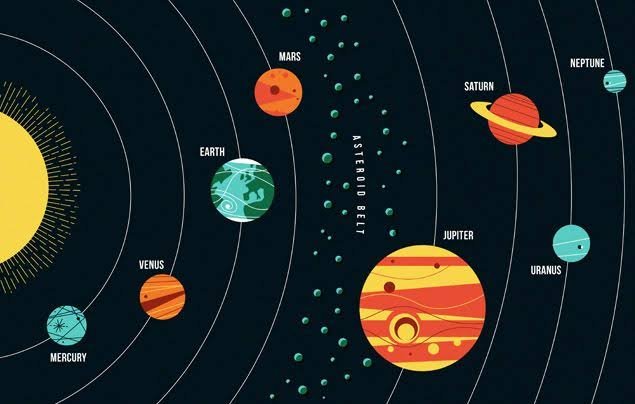
NASA identifies eight planets in our solar system: Mercury, Venus, Earth, Mars, Jupiter, Saturn, Uranus and Neptune. The first four are rocky worlds with solid surfaces. Jupiter and Saturn are gas giants, while Uranus and Neptune are ice giants. The solar system also contains dwarf planets, moons, asteroids and comets. Pluto was reclassified as a dwarf planet in 2006 after astronomers clarified what qualifies as a planet.
3. The Solar System Travels Around the Milky Way
The Sun is not standing still. It, along with the planets and other solar-system objects, orbits the centre of the Milky Way galaxy. NASA estimates that one complete journey takes about 230 million years. Our solar system lies in a smaller region called the Orion Spur, between larger spiral arms. Earth’s daily life feels stable, but our entire planetary neighbourhood is moving through the galaxy at great speed.
4. Light Takes Time to Travel
Light moves extraordinarily fast, but space is so vast that even light needs time to cross it. Sunlight takes about eight minutes to reach Earth. When astronomers observe a galaxy millions of light-years away, they see it as it appeared millions of years ago. A light-year is a measure of distance—the distance light travels in one year—not a measure of time. Telescopes therefore act as time machines, showing earlier stages of cosmic history.
5. Thousands of Planets Exist Beyond Our Solar System
Planets orbiting stars other than the Sun are called exoplanets. NASA’s confirmed catalogue has reached more than 6,000 exoplanets, with many additional candidates awaiting study. Some are giant worlds that orbit extremely close to their stars, while others may be rocky planets. Astronomers often detect them when a planet passes in front of its star and causes a tiny, repeated dip in the star’s brightness.
6. A Black Hole Is Not an Empty Hole
A black hole is an object or region where gravity is so strong that, beyond its event horizon, nothing—including light—can escape. Black holes can form when massive stars collapse, and supermassive black holes occupy the centres of many galaxies. They are invisible when isolated, but surrounding gas can form a hot, bright accretion disk. Scientists also detect black holes by observing how nearby stars, gas and light respond to their gravity.
7. Neutron Stars Pack Enormous Mass into a Tiny Space
When a massive star explodes, its compressed core may become a neutron star. These objects can contain more mass than the Sun inside a sphere only about 20 kilometres across. Their matter is extraordinarily dense, and many spin rapidly while producing beams of radiation. If those beams sweep past Earth, telescopes may detect regular pulses, giving rise to the name pulsar. Neutron stars help scientists study matter under conditions impossible to reproduce on Earth.
8. The Universe Has an Ancient Afterglow
The cosmic microwave background is faint radiation left from the early universe. It was released when the young universe cooled enough for atoms to form and light to travel freely. NASA describes it as the oldest light we can observe. Today, that ancient glow has stretched and cooled into microwave wavelengths. Tiny variations in it provide clues about the early distribution of matter and the later formation of galaxies.
9. There Is No Sound in Empty Space
Sound needs a medium, such as air, water or solid material, to carry vibrations. Most of space is an extremely thin vacuum, so sound cannot travel there in the familiar way it travels through Earth’s atmosphere. Explosions in films are therefore dramatic fiction rather than realistic space acoustics. Spacecraft can still record electromagnetic signals, and scientists can convert some data into sound for research or public demonstrations, but those are not ordinary sound waves travelling through empty space.
10. Space Is Still Full of Unanswered Questions
Astronomers have learned a great deal, yet major mysteries remain. Scientists are investigating dark matter, dark energy, the origins of the first galaxies, the possibility of life elsewhere and the detailed behaviour of black holes. New observations can challenge older ideas and lead to better explanations. The unknown is not a weakness of science; it is the reason exploration continues. Every telescope image and spacecraft mission adds another piece to a much larger cosmic story.
Space is not simply a dark background sprinkled with stars. It is a changing universe of planets, radiation, gravity, stellar explosions and ancient light. Our eight-planet solar system moves through one galaxy among countless others, while telescopes look back across billions of years. The more we learn, the more clearly we see both our small place and our connection to the wider cosmos. Space remains mysterious, but each discovery brings the universe a little closer to human understanding.