When a peacock opens its train, an ordinary patch of ground suddenly becomes a theatre. Hundreds of jewel-like eyes appear in the sunlight, the feathers tremble, and a quiet bird seems to turn into a moving curtain of colour. Yet the display is not simply decoration. It is a carefully evolved signal shaped by courtship, competition, camouflage and survival. The bird’s famous beauty hides remarkable engineering: microscopic structures bend light, specialised feathers create soundless movement, and a surprisingly strong body carries the elaborate train through grass and woodland. Peacocks have inspired paintings, royal emblems and stories for centuries, but their real lives are even more interesting. Here are ten well-researched facts that reveal how these spectacular birds look, communicate, raise their young and survive in the wild.
1. “Peacock” Refers Only to the Male
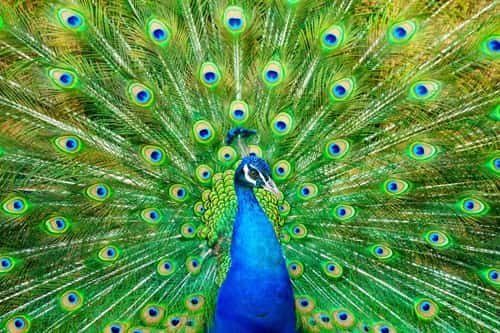
The word peacock is commonly used for the whole bird, but technically it describes an adult male. The female is a peahen, and together they are called peafowl. This distinction matters because males and females look very different. The male Indian peafowl has a brilliant blue neck and a long train covered with eyespots, while the female is usually brown, green and bronze. Her less conspicuous colours help her blend into vegetation while she incubates eggs and protects young chicks. The difference between the sexes is an example of sexual dimorphism, in which males and females of the same species evolve noticeably different appearances.
2. The Famous “Tail” Is Actually a Train
The spectacular feathers that a male spreads into a fan are not his true tail. They are elongated upper-tail covert feathers that grow over the real tail. When the peacock raises the train, the shorter true tail acts like a support system, helping hold the display upright. The train can make the bird appear enormous, but it is made of lightweight feathers rather than solid mass. After the breeding season, the male sheds these feathers during an annual molt. Fresh feathers grow back gradually, ready for the next season’s display.
3. Peacock Colours Come from Light, Not Blue Paint
A peacock’s blue, green and bronze colours are produced largely by microscopic structures inside the feathers. These structures are arranged in layers that reflect some wavelengths of light more strongly than others. The result is called structural colour. It is similar to the shimmering effect seen on soap bubbles or an oil film, although the feather’s design is far more precise. This is why peacock feathers can look different when viewed from different angles. Their colour is not just a surface pigment; it is a small example of natural optical engineering.
4. The Eyespots Are Important Courtship Signals
The circular markings on a peacock’s train are called ocelli, or eyespots. During courtship, a male raises and fans his train so that the pattern becomes visible to nearby females. He may turn, shake the feathers and adjust his position to catch the light. Researchers have studied whether females prefer particular numbers or arrangements of eyespots, but courtship is influenced by several signals rather than one simple measurement. The eyespots make the display memorable, yet the female also receives information from the male’s movement, condition, calls and ability to maintain a strong, coordinated display.
5. The Train Can Vibrate without Making a Loud Flapping Sound
A displaying peacock often shakes his train rapidly. From a distance, the motion looks like a shimmering wave passing through the feathers. The long feathers can vibrate against one another and produce subtle sounds and air movements. Some studies suggest that females may detect vibrations through specialised feathers on the crest or body, although scientists continue to investigate exactly how these signals work in natural conditions. The display is therefore not only visual. It may combine colour, movement, sound and vibration into one complex message.
6. Peafowl Are Omnivores with a Flexible Diet
Peafowl eat both plant and animal food. Their diet can include seeds, grains, fruit, young shoots, flowers, insects, termites and other small creatures. They may also take small reptiles or amphibians when the opportunity arises. This flexible diet helps them use different habitats, from forest edges and grasslands to farmland near villages. Their strong feet help them scratch through leaf litter, while their beaks can pick up small food items. Like many successful wild animals, peafowl are not dependent on one single meal; they adjust their diet to what the season provides.
7. They Are Better Runners Than Flyers
Peafowl can fly, but they are not built for long-distance travel. Their heavy bodies and elaborate feathers make sustained flight difficult. When threatened, they usually run toward cover, using their strong legs and sharp awareness of the surroundings. If necessary, they can burst into the air with powerful wingbeats to reach a tree branch or escape a predator. They often roost in trees at night, where height provides protection. The combination of running, short flights and tree-roosting allows them to survive without being specialised aerial birds.
8. Peahens Raise the Chicks, and the Chicks Are Ready to Move
After mating, the peahen usually makes a simple nest on the ground, often hidden among grass or low vegetation. She lays a clutch of eggs and incubates them herself. The chicks hatch covered in soft down, with open eyes and the ability to walk soon after birth. They follow their mother while learning where to find food and shelter. This early mobility is important because ground nests are vulnerable to predators. The mother’s muted colouring provides camouflage, while her alert behaviour helps the young respond to danger. The male’s magnificent train plays no role in incubating the eggs.
9. Peafowl Use Many Calls, Not Just One “Scream”
Peafowl are vocal birds with a surprisingly broad range of calls. Males may call to attract mates or announce their presence, while females and young birds use different sounds during contact, alarm or distress. Their loud calls can travel through dense vegetation and may help birds remain connected when they cannot see one another. Calls can also warn other animals that a predator is nearby. Although people often notice the peacock’s harsh, dramatic cry, communication includes posture, feather movement, head position and quiet contact sounds as well.
10. There Is More Than One Kind of Peafowl
The birds commonly called peafowl belong to more than one species. Indian peafowl are native to the Indian subcontinent and are the familiar blue-necked birds seen in many parks. Green peafowl are native to Southeast Asia and have a different appearance, with green and bronze plumage. The Congo peafowl, found in Central Africa, is a separate and less familiar member of the group. Green peafowl face serious conservation pressure in the wild, while Indian peafowl have adapted to a range of landscapes. Their differences remind us that “the peacock” is not a single identical bird everywhere.
A peacock’s beauty is easy to notice, but its real wonder lies beneath the spectacle. The famous train is built from specialised feathers, its colours come from microscopic structures, and its display combines posture, movement, sound and vibration. Behind the male’s brilliant performance is the quieter work of the peahen, whose camouflage and careful parenting give the next generation a chance to survive. Peafowl are not merely ornaments of gardens or symbols in human culture. They are adaptable, intelligent birds shaped by forests, fields, predators and seasons. The next time a peacock opens its fan, look beyond the colours. You are watching evolution turn feathers into one of nature’s most extraordinary performances.