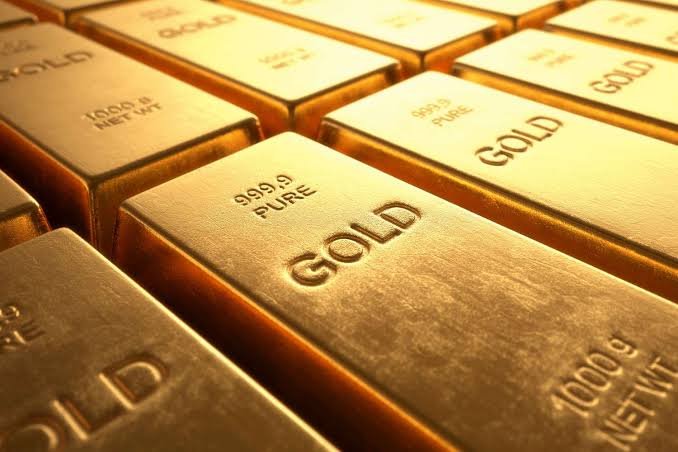
Gold has fascinated people for thousands of years. It has been buried in royal tombs, shaped into coins, worn as jewellery and used today inside phones, spacecraft and medical equipment. Its warm colour and rarity make it beautiful, but beauty alone does not explain its importance. Gold is unusually stable, easy to shape, an excellent conductor and almost impossible to destroy. A tiny amount can be beaten into a huge sheet or drawn into a remarkably long wire. From its atomic structure and cosmic origin to its role in technology and the environment, gold is far more than a symbol of wealth. These ten facts reveal why this ancient metal remains one of the most useful and intriguing elements on Earth.
1. Gold Is Element Number 79
Every gold atom contains 79 protons in its nucleus. This number, called the atomic number, gives gold its identity. Its chemical symbol is Au, taken from the Latin word aurum, meaning “shining dawn”. Gold atoms also contain neutrons and electrons, but changing the number of protons would create a different element. On the periodic table, gold belongs to the transition metals. Its stable atomic structure helps explain its distinctive colour, density and resistance to chemical change.
2. Gold Is One of the Least Reactive Metals
Gold does not easily react with oxygen, water or most ordinary acids. That is why gold jewellery does not rust like iron and can remain bright for centuries when cared for properly. Gold can dissolve in aqua regia, a powerful mixture of nitric and hydrochloric acids, but common household substances cannot easily attack it. This chemical stability is one reason ancient coins, ornaments and artefacts have survived for so long. It also makes gold useful for electrical contacts, where corrosion could interrupt a signal.
3. Pure Gold Is Soft and Highly Malleable
Pure gold is surprisingly soft compared with many everyday metals. It is extremely malleable, meaning it can be hammered into thin sheets without breaking, and ductile, meaning it can be stretched into wire. One ounce can be beaten into gold leaf covering several square metres or drawn into a wire many kilometres long. Because pure gold is too soft for most rings and tools, jewellers mix it with metals such as copper, silver or palladium. These alloys improve strength and can change the colour to white, rose or pale yellow.
4. Karat Tells Us How Much Gold an Alloy Contains
The word karat describes the purity of gold used in jewellery. Twenty-four-karat gold is treated as nearly pure gold, while 18-karat gold contains 18 parts gold out of 24, or 75 percent. In many countries this is marked as 750. Fourteen-karat gold contains 14 parts gold, and 9-karat gold contains 9 parts. Lower-karat jewellery is generally harder and more affordable because it contains more strengthening metals. Karat should not be confused with carat, the unit used for the weight of gemstones.
5. Gold Was Forged in Ancient Stars
Gold is not made naturally by ordinary chemical reactions on Earth. Its heavy atomic nucleus formed in extremely energetic cosmic events, most likely collisions involving neutron stars and certain stellar explosions. The material later became part of the cloud from which the Solar System formed. Over geological time, natural processes concentrated tiny amounts of gold in rocks, river sediments and underground veins. Every gold ring therefore contains atoms that are older than Earth and were created in a violent event far beyond our planet.
6. Almost All Gold Ever Mined Still Exists
Gold is practically indestructible. It may be melted, reshaped, buried or dissolved during processing, but the gold atoms themselves do not disappear. The World Gold Council estimates that roughly 219,890 tonnes of gold had been mined throughout history by early 2025, and almost all of it remains in some form. It may be held as jewellery, coins, bars, technology components or museum objects. This makes gold different from fuels and many industrial materials, which are consumed or destroyed after use. Recycled gold can return to the market again and again.
7. Gold Has Been Used as Money and a Store of Value
Civilisations used gold for decoration and trade long before modern banking. Gold coins were produced in the ancient kingdom of Lydia around the seventh century BCE, and many empires later used gold in their monetary systems. Gold became valuable because it is rare, portable, divisible, recognisable and resistant to decay. Today most countries use government-issued paper or digital currencies, but central banks still hold gold reserves. Investors also buy bars, coins and financial products because gold is often viewed as a store of value during periods of uncertainty.
8. Gold Is Important in Electronics and Space Technology
Gold conducts electricity and does not corrode easily, making it valuable in connectors, switches and fine wires. Small amounts may be found in computers, phones, medical devices and communication equipment. Gold is also useful in spacecraft. Thin gold coatings can reflect infrared radiation and reduce unwanted heat, while gold-plated surfaces help protect sensitive instruments. Its reliability matters more than its quantity: a tiny contact made from gold may help a device work for years in conditions where an ordinary metal would oxidise or fail.
9. Gold Has Medical and Scientific Uses
Gold has been used in dentistry because certain gold alloys are durable and resistant to corrosion. Some gold compounds have also been used in the treatment of particular medical conditions, although they must be prescribed and monitored carefully. Scientists study gold nanoparticles because their small size gives them unusual optical and chemical properties. They are being explored in imaging, sensors, drug delivery and diagnostic tests. Research does not mean every gold product is a proven treatment; medical uses require evidence about safety, dose and effectiveness.
10. Gold Mining and Recycling Have Environmental Costs
Gold is valuable, but obtaining it can disturb land, consume energy and affect water if mining is poorly managed. Ore often contains only a small concentration of gold, so large amounts of rock may need to be excavated and processed. Responsible mining requires safety standards, careful waste management, land restoration and protection of local communities. Recycling is also important because electronic waste and old jewellery contain recoverable gold. Reusing existing metal can reduce the need for new mining, although recycling itself requires collection systems and careful processing. Gold’s future depends not only on finding it, but on using it responsibly.
Gold is memorable because it combines beauty with remarkable science. Its 79-proton atoms are stable, its colour is distinctive, its surface resists corrosion and its softness allows it to be shaped in extraordinary ways. The same metal has served ancient rulers, modern engineers, doctors, investors and artists. Yet gold also reminds us that valuable materials carry responsibilities. Better recycling, safer mining and thoughtful use can help preserve its benefits while reducing harm. From ancient riverbeds to distant stars, gold connects human history with the deepest story of matter itself.