Chemistry is the quiet drama unfolding inside every ordinary moment. When bread rises, a match burns, a metal spoon tarnishes or a lemon tastes sour, atoms and molecules are rearranging according to precise rules. The same science allows a green leaf to capture sunlight, a battery to power a phone and a medicine to act inside the body. Chemistry is not confined to colourful liquids in a laboratory; it is the language of matter, energy and change. It connects the smallest particles to major questions about health, food, technology and the environment. These ten facts move from atoms and the periodic table to water, enzymes, colour, modern materials and cleaner solutions.
1. Chemistry Studies Matter and Its Changes
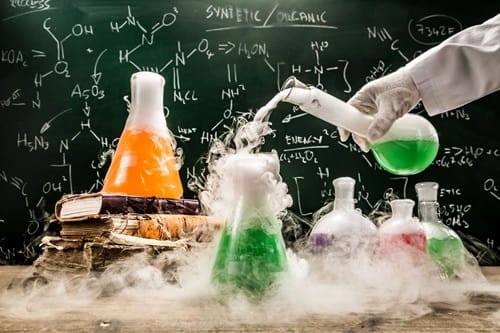
Chemistry examines what substances are made of, how their particles are arranged and how they change. Matter may be a solid, liquid, gas or, under special conditions, plasma. A physical change alters shape or state without creating a new substance, as when ice melts or water evaporates. A chemical change creates substances with new properties, as when wood burns, food cooks or iron rusts. Signs of a reaction may include a colour change, gas bubbles, a precipitate, light or a temperature change. Chemists use measurements, experiments and models to distinguish real evidence from guesswork.
2. Everything Is Made of Atoms
Atoms are the basic units of ordinary matter. They contain a tiny nucleus of protons and neutrons, surrounded by electrons in regions of space called orbitals. The number of protons gives an element its identity: every carbon atom has six, while every oxygen atom has eight. Atoms of the same element can have different numbers of neutrons; these forms are isotopes. Atoms may share, gain or lose electrons to form chemical bonds. They join into molecules and compounds, creating the enormous variety of air, rocks, oceans, cells, medicines and manufactured materials. Although atoms are incredibly small, their arrangement determines whether a substance is soft or hard, reactive or stable, poisonous or useful.
3. The Periodic Table Is a Map of Chemical Behaviour
The periodic table arranges elements by atomic number and reveals repeating patterns in their properties. Elements in the same group often behave alike because their outer electrons are arranged in similar ways. The alkali metals are highly reactive, the noble gases are unusually unreactive and the halogens readily form salts with metals. The table also separates metals, non-metals and metalloids, while showing trends such as atomic size and attraction for electrons. Scientists use it to predict reactions, choose materials and understand newly discovered elements.
4. Water Has Unusual Properties
Water is a simple compound made from two hydrogen atoms and one oxygen atom, yet its behaviour is remarkably unusual. Because its molecules are polar, water dissolves many salts and other substances, transports nutrients through blood and soil, and participates in countless reactions. It absorbs a large amount of heat, helping organisms and oceans resist sudden temperature changes. Unlike most solids, ice is less dense than liquid water, so it floats and forms an insulating layer on ponds. Water molecules also cling to one another, producing surface tension that allows tiny insects to stand on the surface and helps plants draw water through narrow vessels. These properties make water essential to life and climate.
5. Chemical Reactions Involve Energy
Chemical reactions can release energy, absorb energy or transfer it in stages. A candle releases heat and light as wax reacts with oxygen, while some instant cold packs absorb heat from their surroundings. Plants capture sunlight and store its energy in the bonds of sugars through photosynthesis. Batteries use controlled reactions to push electrons through a circuit and produce electricity. In the body, cellular respiration gradually releases energy from food rather than releasing it in one dangerous burst. A reaction’s energy change depends on the difference between the starting substances and the products. Understanding this balance helps engineers design fuels, refrigerators, solar cells and safer industrial processes.
6. Catalysts Make Reactions Faster Without Being Used Up
A catalyst helps a reaction happen more easily by providing a pathway with lower activation energy. It is not permanently consumed in the overall reaction, although it may need to be recovered or cleaned in an industrial plant. Enzymes are highly selective biological catalysts that allow digestion, energy release and DNA copying to occur quickly enough for life. A small change in temperature or acidity can affect an enzyme’s shape and activity. Industrial catalysts help manufacture fuels, fertilisers, plastics and medicines while reducing energy use and unwanted waste. Catalysts do not change the final balance of a reaction; they mainly help the system reach that balance faster.
7. Your Body Is a Chemical Laboratory
Digestion, breathing, movement and thinking all depend on chemical reactions. Enzymes break food into smaller molecules, blood carries dissolved substances and cells use oxygen to release energy from nutrients. Muscles contract through interactions involving proteins, minerals and energy-rich molecules. Hormones act as chemical messengers, and nerve cells communicate using charged particles and neurotransmitters. DNA stores information in the order of its molecules, while proteins carry out much of the cell’s work. The body remains alive by controlling thousands of reactions through temperature, acidity, hormones and feedback systems. Even a heartbeat is the visible result of carefully timed molecular events.
8. Chemistry Explains Colour and Smell
A substance’s colour can result from the wavelengths of light its molecules absorb and reflect. Chlorophyll absorbs light in a way that makes leaves appear green, while many pigments protect plants or attract pollinators. Smell depends on volatile molecules reaching receptors in the nose. Tiny structural differences can produce completely different scents: one molecule may smell fruity while a close relative smells unpleasant. Perfumes, food flavourings, dyes, cosmetics and medicines all depend on understanding how molecules interact with light, air, water and sensory receptors. Chemists can identify unknown substances by studying the light they absorb or emit, making colour a useful scientific clue rather than mere decoration.
9. Chemistry Can Create Materials Nature Never Made
Chemists design polymers, medicines, coatings, batteries, fibres, ceramics and electronic materials with chosen properties. Plastics are made from long chains of repeating molecules, while modern materials may be engineered to conduct electricity, resist heat, block ultraviolet light or break down more safely. Glass, concrete and many medicines also depend on controlled chemical design. Synthetic materials are not automatically harmful or beneficial; their effects depend on structure, dose, use, disposal and environmental interaction.
10. Chemistry Helps Solve Global Problems
Chemistry is central to clean water, low-carbon energy, food production, disease treatment and recycling. Researchers are developing better batteries, greener manufacturing methods, safer fertilisers, biodegradable materials and ways to capture or use carbon dioxide. Water treatment depends on reactions that remove microbes and pollutants. Medicine depends on molecules that can recognise targets in the body. Sustainable chemistry aims to use safer ingredients, less energy and renewable raw materials while producing less waste. The field teaches an important lesson: solving a problem requires understanding both the useful properties of a substance and the risks created when it is produced, transported or released.
Chemistry gives ordinary experiences a deeper meaning. A bubbling drink, a glowing flame, a green leaf, a tablet that reduces pain and the steel in a bridge are all examples of matter following chemical rules. Once we understand atoms, molecules, energy and reactions, the world begins to look like a vast living laboratory. Chemistry explains nature, improves daily life and gives people the tools to design safer materials and wiser solutions for the future.